


A few years ago, standing in line at a telecom service center meant taking a token, sitting under harsh white lights, and watching numbers crawl across a red LED board. Today, many of those same problems get solved through a chat window that pops open before frustration fully forms. That small shift — from queue to click — captures why digital CX tools matter. They don’t just speed things up. They reshape the emotional temperature of an interaction.
Digital CX tools work best when they disappear into the experience. A good live chat system doesn’t feel like software; it feels like access. A well-timed automated message can feel less like marketing and more like anticipation. Companies that understand this design for flow, not features. The technology is visible only when it fails.
The most obvious improvement comes from response time. Customers no longer measure service quality in days or even hours. Minutes feel long. Modern helpdesk platforms route tickets automatically, suggest replies to agents, and pull customer history into one screen. That last detail is underrated. Repetition — explaining the same problem to three different representatives — is one of the fastest ways to sour a relationship. When a support agent begins with context instead of questions, the tone changes immediately.
Speed alone, though, is not experience.
What digital customer journey tools increasingly do well is memory. They remember preferences, past purchases, abandoned carts, prior complaints, browsing patterns, and sometimes even hesitation. A returning customer sees recommendations that are uncannily close to what they were already considering. A banking app surfaces the exact service link a user searched for last week. A travel platform nudges a half-finished booking with updated prices before the customer checks elsewhere.
This can feel helpful or invasive depending on execution. The line is thin and moves often.
Personalization engines and CRM systems have turned customer history into an operating asset. Retailers once relied on the instincts of a good floor manager who recognized repeat visitors. Now recognition is industrialized. The advantage is scale. The risk is awkwardness. Everyone has received an email that begins with their name and then proceeds to misunderstand them completely. Digital tools improve experience only when the data behind them is interpreted with restraint.
Chatbots are another interesting case. Early versions felt like badly written phone trees converted into text. They trapped users in loops and mistook keywords for intent. The newer generation — trained on broader language patterns and integrated with backend systems — handles routine work surprisingly well. Password resets, delivery updates, appointment scheduling, simple troubleshooting — all resolved without waiting for a human.
Customers rarely celebrate a chatbot interaction, but they often appreciate not needing a human for small tasks. Quiet efficiency earns more loyalty than theatrical friendliness.
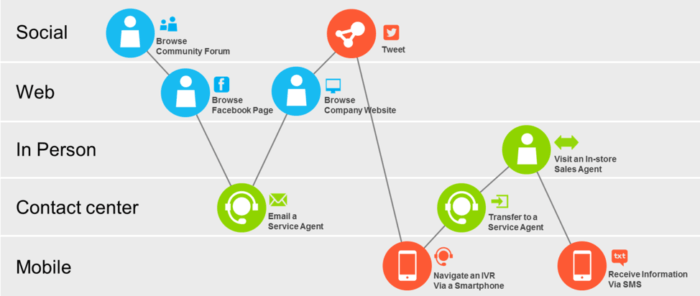
Journey mapping software has also changed how organizations see their own blind spots. Instead of measuring isolated metrics — call time, resolution rate, click-through — companies can now visualize the full customer journey across channels. Where do people drop off? Where do they hesitate? Where do they switch from mobile to desktop? These patterns used to require guesswork and scattered reports. Now they appear as paths with friction points highlighted like traffic warnings.
When teams see the journey laid out visually, debates change. Opinions give way to patterns.
There is also a subtle cultural shift inside companies that adopt serious CX platforms. Decision-making moves closer to evidence. Product teams watch session recordings. Support teams tag recurring complaints. Marketing teams see which promises generate confusion downstream. Digital CX tools create a shared factual layer that reduces internal storytelling. Not entirely, but noticeably.
I still remember watching a product manager wince during a user session replay where a customer clicked the wrong button six times in a row.
Feedback tools deserve more credit than they get. Short in-app surveys, post-interaction ratings, and micro-feedback widgets produce streams of small signals. One message is noise. A thousand messages reveal structure. Smart systems cluster sentiment and detect recurring themes automatically. Instead of quarterly survey reports, companies get rolling emotional dashboards. That changes response speed. It also makes denial harder.
But tools don’t automatically produce empathy. They produce visibility. Empathy still requires interpretation and will.
Automation plays a complicated role in customer experience. Automated email journeys, triggered messages, and lifecycle campaigns can guide customers through onboarding and usage with impressive precision. The best sequences feel like gentle nudges. The worst feel like relentless pursuit. Timing is everything. Frequency is judgment. Digital CX tools provide the controls, but humans set the pressure.
There’s also the matter of consistency. Customers now move between channels without thinking about it — starting on mobile, continuing on laptop, finishing in an app. CX platforms synchronize these touchpoints so conversations continue instead of restart. A complaint logged on social media appears in the support console. A web chat transcript is visible to the call center agent. This continuity used to be rare. Now it’s becoming expected.
Expectation is the real engine here.
Analytics layers built into digital CX tools also change what companies choose to improve. When dashboards show that customers abandon a form at a specific field, that field gets redesigned. When heatmaps show users ignoring a major banner, the banner disappears. Decisions become more surgical. Less redesign, more adjustment. Incremental experience improvement beats grand relaunches more often than teams like to admit.
There is a danger, though, in over-optimization. When every click is measured, organizations can become obsessed with friction removal at the cost of character. Not every pause is a problem. Not every detour is waste. Some experiences benefit from texture — browsing, discovery, surprise. Digital tools are excellent at smoothing surfaces. They are not always good at preserving charm.
Privacy concerns sit just beneath the surface of all this progress. The same data that enables relevance enables surveillance. Regulations have pushed companies toward transparency, but customer understanding still lags behind data collection practices. Trust becomes part of the experience equation. A fast, personalized interaction loses value if it feels extractive. The most respected brands now treat data minimization as a feature, not a constraint.
Small businesses are entering this space too, which may be the most encouraging development. Tools that once required enterprise budgets are now available as subscriptions cheaper than office rent. A local retailer can deploy chat support, automated follow-ups, and customer tracking without hiring a technical team. The experience gap between large and small players is narrowing — not evenly, but visibly.
The pattern across industries is clear: digital CX tools improve customer experience when they reduce effort, preserve context, and respect attention. They fail when they try to simulate care instead of enabling it.
Customers don’t ask for software. They ask for clarity, speed, and to not repeat themselves. The best digital CX systems understand that and stay out of the way.
