

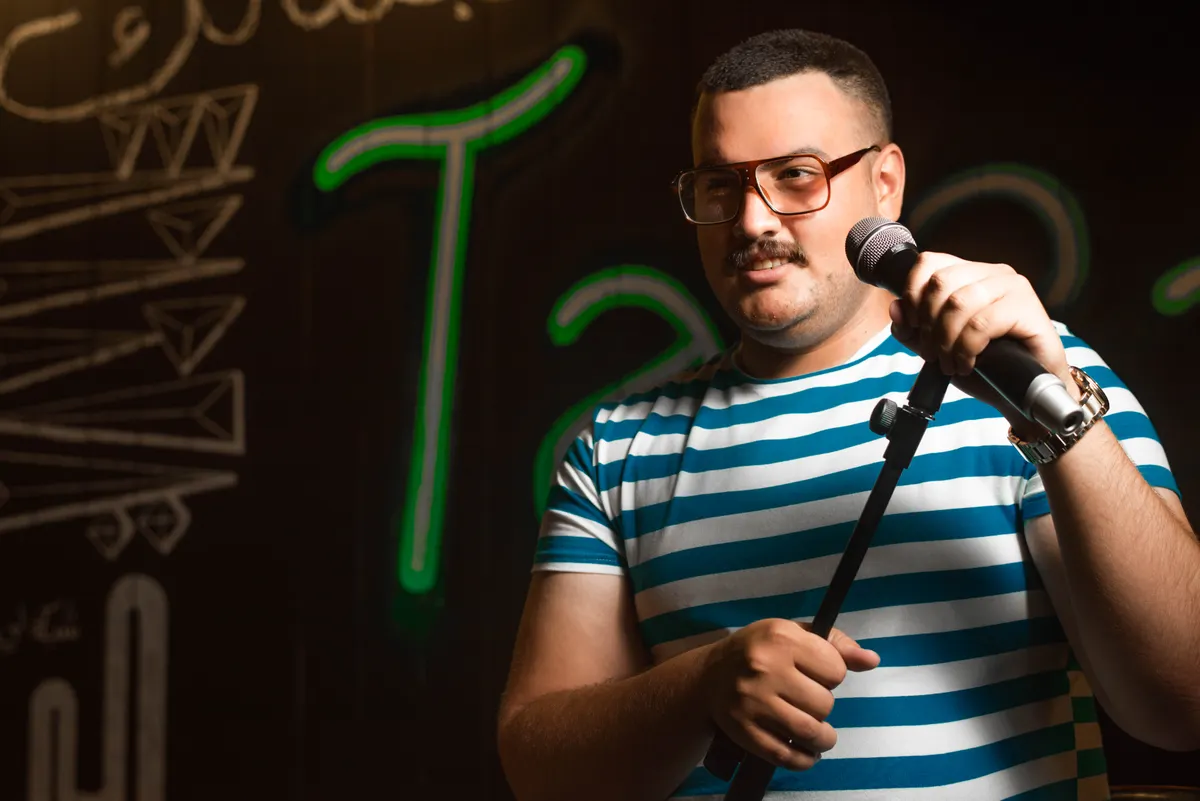

There is a particular art to dealing with Ola Labib hecklers on stage, and it involves, above all else, the appearance of infinite sweetness. ‘My method is to rage bait in the sweetest way possible,’ says Labib, the stand-up comedian, actor and author who has been performing for almost ten years across the UK, from the O2 in London to Glasgow to her hometown of Portsmouth.
The method works like this: when a drunk man begins slurring incoherent noises through her set, Labib does not lose her composure. She leans into it. Oh sweetheart, do you want your voice heard? Do people not listen to you at home? Are you a bit lonely? Do you want to come on stage for one or two minutes? The invitation is extended with great ceremony. It is never accepted. ‘It’s always men that want to show the audience that they are funnier than you,’ she says. ‘Lots of people have asked if I’ve ever considered being a schoolteacher for really naughty kids, but no, I prefer full-grown twatty adults, thank you very much.’
A Career Built on Material That Only She Could Make
Labib’s comedy draws on her British Sudanese identity, her Islamic upbringing and her years working as a pharmacist, a CV that gives her a perspective most rooms have never encountered before she walks into them. She appears on Channel 4‘s The Pharmacy, and she has published as an author alongside her stage work. Last month, she received an honorary fellowship from Rose Bruford College for her contributions to the field.
That fellowship carries some weight. Chortle reports that Rose Bruford is a theatre school in South-East London, and Rose Bruford College notes that Labib completed her first sold-out tour in 2024, a milestone that contextualises the fellowship as recognition of a career with demonstrable commercial traction, not merely critical favour. A sold-out tour and an honorary fellowship in the same broad chapter of a comedian’s life suggest that the rooms, and the institutions, are catching up with her.
‘You’re always going to get negativity,’ she says, ‘especially looking like me.’ Heckling, she is clear-eyed about, is simply part of the work. At its most useful, it hands her material; at its ugliest, it tips into racist and prejudiced abuse. She navigates both with the same surface-level patience.
Eight and a Half Months Pregnant, and a Stag Do in the Front Row
The story that best illustrates what Labib means by ‘you have to expect anything’ involves a stag do, a man with a fixation on his own teeth, and a chair thrown across a room. She was eight and a half months pregnant. Certain clubs, she explains, will warn a comedian in advance if a stag party is in attendance; this one had every intention of being disruptive from the start.
The man was, in her telling, so drunk he was barely coherent. What she could parse, between the slurring, amounted to an announcement that he had massive teeth. The assumption, she says, was that her being ‘this short, petite, pregnant woman’ meant she would simply absorb the interruptions and continue. She did not. She invited him onto the stage to tell a knock-knock joke.
His response was immediate. ‘He was like, “What’s your effing problem?” He threw his chair back, and I genuinely thought he was going to come punch me in the face.’ The moment passed. The set continued. This is, by now, something close to routine for a comedian a decade into a career that has required her to hold a room under conditions most performers would find reason to avoid.
The fellowship from Rose Bruford College, the sold-out tour behind her, and a television credit to her name: the industry is, it seems, beginning to formalise what audiences in Portsmouth and Glasgow and the O2 have known for some time.
