


Duran Lantink Jean Paul Gaultier is, by most measures, an unlikely pairing: a Dutch designer known for silicone torsos and sex-shop props, handed the keys to one of Paris couture’s most theatrical houses. And yet, a year and a half into his tenure, something about it makes perfect sense.
It started, as so many fashion origin stories do, with an act of minor domestic destruction. As a child growing up in The Hague, Lantink would raid his mother’s wardrobe not to dress up in her clothes but to take scissors to them. His mother, a fashion-loving interior designer, would ‘freak the fuck out’ at finding a favourite Margiela in pieces. Lantink giggles wickedly at the memory. ‘But it was a good investment, I guess.’
Now in his late thirties, those scissors have found a grander wardrobe to work on. Jean Paul Gaultier retired from design after presenting his 50th-anniversary couture show in January 2020, leaving behind a house that has operated on a guest-designer model ever since. Lantink, who founded his own brand in 2016, took the role of creative director and made his couture debut with a collection that suggested he had absorbed both the house’s irreverence and its commitment to spectacle in one very concentrated sitting.
The Couture Show That Set the Tone
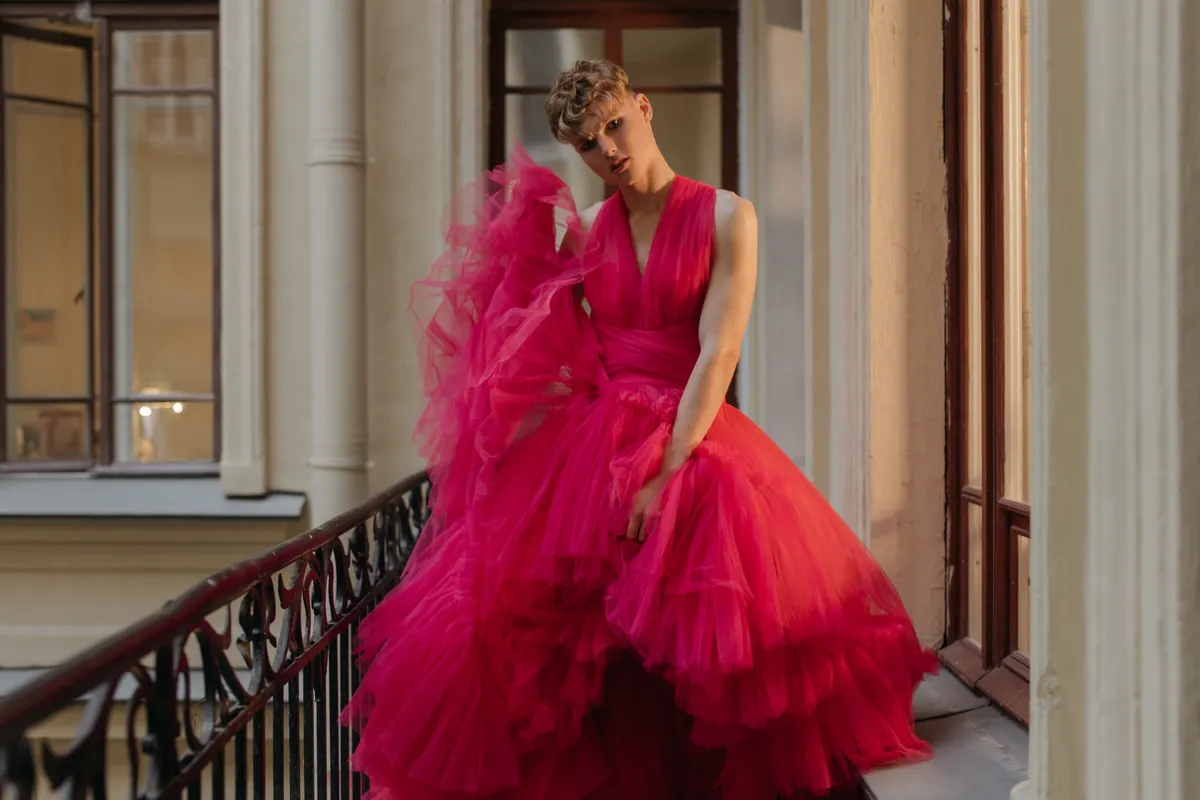
His debut sent chassis-like dresses down the runway, their hips built from tubes that spilled geysers of tulle as the models swaggered past. Lacquered torsos rippled and warped as though the fabric itself were glitching. The proportions were inspired by Marie Antoinette. ‘That was a woman who would make herself almost above humanity,’ he says. ‘She would make herself completely unfunctional and say: I’m better than you, I’m just here as a statement.’ The influence of Gaultier, for whom cheekiness was always structural rather than decorative, is audible in every syllable.
‘Couture nowadays, besides Schiaparelli, feels quite wearable and light,’ Lantink observes, with the mild impatience of someone who finds wearability a rather pedestrian ambition. His designs traffic in human-defying proportions: chin-high bodices, pointy-shouldered jackets, jutting panniers. The body, for Lantink, is a starting point rather than a constraint.
This was always so. As a student in Amsterdam, his trademark was upcycling, splicing together existing garments. Eventually, boredom intervened. ‘I thought: okay, how can we actually transform a clothing piece without combining it?’ By the time he launched his own label, he was stuffing polystyrene balls into fabric to warp the silhouette, pulling objects from around the studio to alter a garment’s shape. ‘You’re like, oh my God, maybe we should put that basket in and see what happens,’ he says, gesturing to a basket in his Paris studio. Fittings remain central to his process; he does not sketch or build moodboards. ‘I like the interaction with the model, the clothes and your team, to see where it goes. It almost always ends up going somewhere exciting.’
Duran Lantink at Jean Paul Gaultier: Controversy and the Comment Section
Exciting, in Lantink’s world, carries a certain statutory level of outrage. The swan song show for his eponymous brand in AW25, before he took the top job at Gaultier, caused commotion after he sent two models down the runway wearing silicone bodies: a female model in a male torso, a male model in a pair of bouncing breasts his team bought from a Paris sex shop. The outfits drew accusations of misogyny and poor taste; rumours circulated that the silicone pieces had been purchased from Amazon. ‘People said how dare I use Amazon in a fashion show!’ he says, laughing. ‘Isn’t everybody on Amazon? Isn’t that the most relevant thing of today?!’ For the record, they were not from Amazon.
Six months later, his first ready-to-wear show for Gaultier featured a naked bodysuit, hairy phallus included, and the internet obliged with accusations that he was desecrating the house’s legacy. He was clearly aiming for cheekiness rather than controversy, and says the extremity of the reaction caught him off guard. ‘Obviously it does hurt me a little bit,’ he says, adding that he no longer reads the comments. His deeper concern is structural. ‘It’s just a small wave of people who are angry and the clickbait favours hate comments because they perform well. But the next day they’re angry about something else. Where’s the music? Where’s the art?’
The house he now steers sits within Puig, which reported revenues of €4.79 billion and profits of €530 million in 2024, according to Vogue. That is the financial architecture within which Lantink’s chaos must eventually find its commercial logic, and it is partly why the freedom he describes feels genuinely hard-won.
He visits Gaultier at his Paris home every few weeks. The two share a love of Absolutely Fabulous and gossip about the industry together. ‘We hate each other! No, we love each other. I mean, I love him, I don’t know if he loves me,’ Lantink says. ‘But we have a good relationship.’ An only child whose father died when he was six months old, Lantink spent much of his childhood in make-believe, playing with Barbies and creating fantasy worlds while his young, glamorous mother threw parties he watched from a quiet distance. ‘It made me feel like there was another world than my elementary school, where everybody was quite toned down.’
The job at Gaultier has brought him something he did not entirely expect: a version of calm. Relieved of the financial and production burdens of running his own label, he walks the 9th arrondissement, visits the Louvre, watches people at the Palais Garnier. He still cuts up his clothes. ‘It’s less, but it’s still happening,’ he says. Issue 77 of 10 Magazine, FUTURE, LEGACY, HERITAGE, reaches newsstands on 18 September.
