

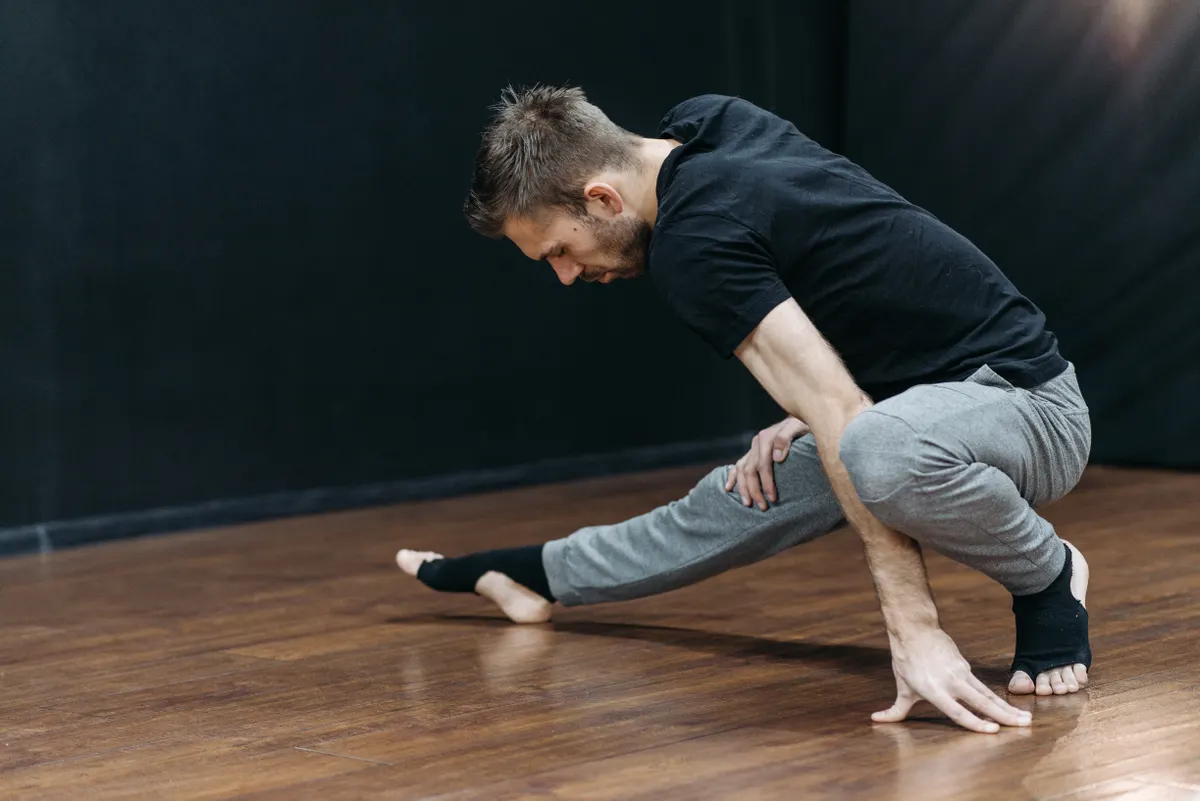

The sit-to-stand test fitness world has quietly known about for years has a way of cutting through every expensive wellness metric: can you lower yourself to the floor, cross your legs, and get back up again without once pressing a hand to the ground? It sounds deceptively minor. It is not.
What the sit-to-stand test actually measures
The movement draws on a surprisingly broad coalition of physical qualities: leg strength, core stability, hip mobility, balance, and the kind of fluid coordination that tends to erode, almost imperceptibly, with age and sedentary habit. It is commonly known as the sit-to-stand test, and it is used by medical professionals as a rapid, equipment-free means of evaluating overall health and fitness.
The appeal, practically speaking, is obvious. You need no treadmill, no grip dynamometer, no laboratory. A clear patch of floor and thirty seconds are sufficient. During the pandemic, when clinics contracted and home consultations became the norm, doctors found the sit-to-stand test particularly useful for measuring exercise capacity in small spaces, or when a patient had no access to specialist equipment at all. A crisis has a way of clarifying which tools are genuinely portable.
The test itself is straightforward. Stand in bare or flat-soled feet on a clear surface. Lower yourself to sitting cross-legged on the floor, using as little hand, knee, or forearm support as possible. Then rise back to standing, again without pressing hands or arms into the floor for assistance. Each support used counts against your score. The ideal is a clean, unassisted descent and ascent.
The longevity question
It is the research into lifespan that lends the test a more arresting dimension. Studies suggest that the sit-to-stand test could predict how long you will live, though it is worth noting that this work has, so far, been conducted only on older adults. The caveat matters. Extrapolating those findings to a thirty-five-year-old who simply finds the move awkward after a decade at a desk would be premature.
What the research does indicate, more broadly, is that the physical qualities the test draws upon (muscular strength, flexibility, and neuromuscular coordination) are among the better long-term markers of functional health. Losing them quietly, without noticing, is precisely how people find themselves in difficulty later. The test makes the invisible visible in half a minute.
Think of it less as a verdict and more as a prompt. Most of us spent years on the floor as children: cross-legged in classrooms, scrambling up from grass, folding ourselves into improbable positions without a second thought. That ease does not have to be entirely surrendered to adulthood. It does, however, require some attention to maintain.
A practical starting point
If the movement is presently difficult, the answer is not to avoid it but to work around its components. Hip flexor mobility, single-leg strength, and thoracic flexibility all contribute. Yoga practitioners tend to find the test easier, not because yoga is uniquely superior, but because it regularly asks the body to move through ranges of motion that office hours do not.
The sit-to-stand test, in that sense, is less a party trick than a useful mirror. Getting up off the floor without using your hands is one of those physical benchmarks that most people never think to test until the day they find it genuinely hard. Better, perhaps, to check now, while there is still plenty of time to do something about what you find.
