


The 10 Magazine Erykah Badu interview from Issue 64 is one of those rare archive pieces that rewards returning to, not because the subject has softened into something more palatable over time, but because she hasn’t. Shot by Shaniqwa Jarvis in Dallas and styled by Anna Trevelyan, the cover sees Badu in a floral construction by Richard Quinn: voluminous, unapologetic, entirely correct. The conversation inside, conducted by Owen Myers, is something else altogether.
Badu has spent the better part of three decades being genuinely, productively unknowable. The woman who released Baduizm in 1997 rooted her debut in lounge jazz, spoken word and slow-cooked soul at a moment when the genre was tilting hard toward a sleek Y2K futurism. While Missy Elliott and TLC were reorienting R&B with digital maximalism, Badu arrived sounding as though she had been here before, drawing on the Five-Percent Nation, black hair politics and the quieter, more dangerous corners of street life. The record landed like a counter-argument to everything happening around it.
The Erykah Badu 10 Magazine Interview and the Business of Badu World Market
By the time Myers speaks to her, Badu is in a characteristically unhurried mode. She is calling from Dallas just before the new year, having shaken off the “uneasy” feelings brought on by December’s Blood Moon in time for a quiet Christmas with her three children. Her pace is deliberate: she has released an album, on average, once every half-decade since the late 1990s. “If I have a baby, you might not see me for five years,” she says, without apparent concern about how this lands.
Her immediate focus is Badu World Market, an online store that was set to open on 20 February. The inventory is characteristically wide-ranging: bespoke clothing and accessories, apothecary goods, holistic items including glass water bottles infused with amethyst, rose quartz or turquoise, oversized crocheted coats from her clothing line Fuh, and mouth grills inspired by the winged Egyptian goddess Ma’at. There are also geta, a traditional wooden Japanese form of footwear that Badu says she has worn since fifth grade and has collected in excess of 70 pairs. “That’s where artistry meets spirituality meets tradition,” she tells Myers. “Ancient-futuristic fashion.”
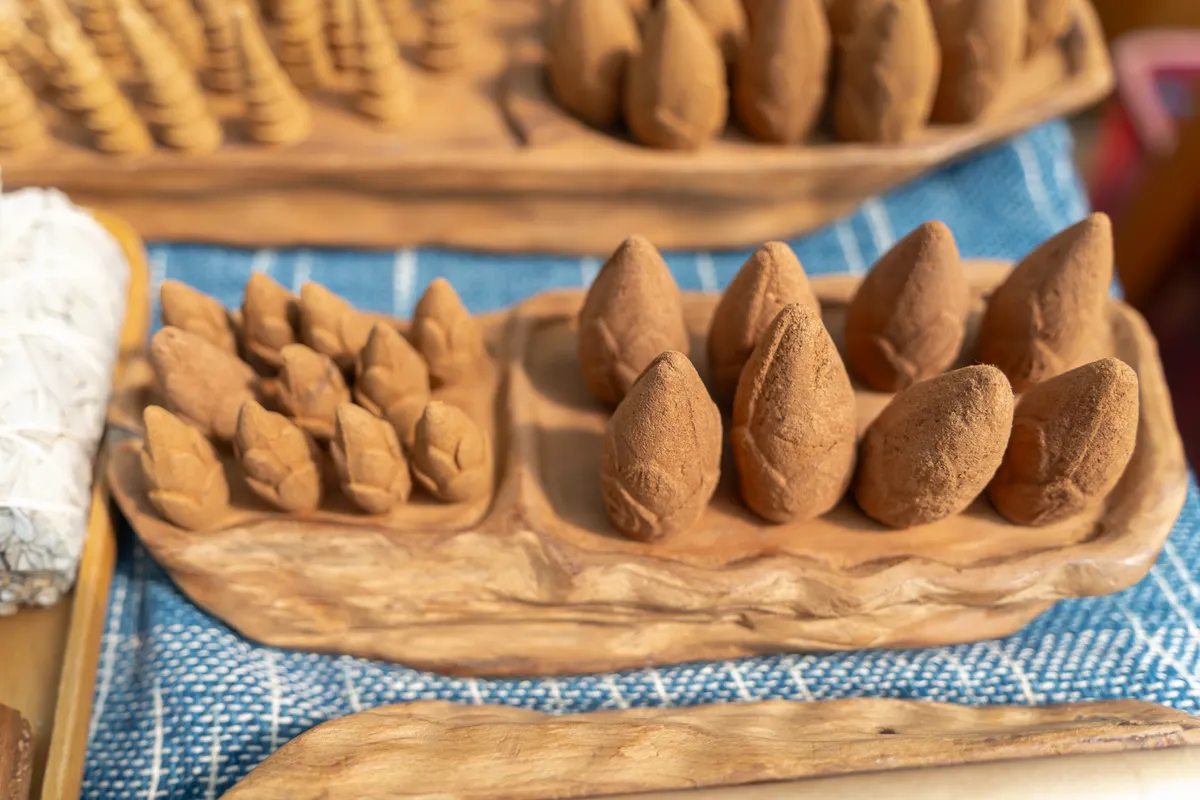
And then there is the item that will, inevitably, be the one most written about. Badu has made incense that smells like her vagina. The product, named Badu’s Pussy, was produced by cutting up pairs of her own underwear, burning them, and incorporating the ash. “The people deserve it!” she says, hooting with laughter. She has long since stopped wearing anything under her clothes, so the sacrifice of the underwear drawer was not a painful one.
Style, Performance Art and the Archive That Rewards a Wormhole
The 1990s style documentation is worth dwelling on. The decade was, broadly, a moment of salmon-toned Ralph Lauren minimalism on red carpets. Badu was doing something different: a plunging hot pink dress with a teddy-bear coat, a Jamaican-flag-printed jumpsuit anchored by a foot-high head wrap. “When you come out as an artist, you have to make sure that when you show up, they know it’s you,” she says. “Not just from your voice, but aesthetically as well.” The awareness was deliberate. “Of course!” she says when asked if she was conscious of standing out. “All my life.”
She has since appeared in campaigns for Tom Ford and Givenchy, and made her runway styling debut for Pyer Moss’s AW16 show at New York Fashion Week. In 2012, Riccardo Tisci called her “the exact definition of style.” What has remained consistently underacknowledged, Badu suggests, is her work as a visual auteur: she conceptualises, directs and edits all her music videos herself. The 2010 video for Window Seat, filmed guerrilla-style through the streets of Dallas as she stripped down to nothing while dodging passers-by, was, she says, “pretty much in the vein of performance art. Like Yoko Ono and Josephine Baker.”
Her theatrical instincts were formalised early. While studying at Grambling State University in Louisiana, she appeared in a production of Ntozake Shange’s 1976 work For Coloured Girls Who Have Considered Suicide / When the Rainbow Is Enuf, a production she later reinterpreted for the 2000 video for Bag Lady. The piece’s handwritten sign reading “Too Black” was not incidental. “There was a time in the history of this world where [dark skin on black women] was unacceptable,” Badu says. “We’re still trying to spin out of it now.”
The interview does not sidestep the more difficult passages of the public record. A 2018 interview in Vulture, in which Badu declined to condemn Bill Cosby and described Adolf Hitler as a “wonderful” painter, wounded and confused many of her listeners. In Myers’s conversation, she describes the resulting backlash as “group lynchings” and uses the term “offendocracy” to characterise those who criticised her. She is equally warm, in the same breath, about movements like #MeToo: “The intentions of those things are wonderful. It is an issue that has been ignored for many centuries.”
Since 2001, Badu has also worked as a doula, taking roughly three clients a year. She fell into the work after sitting with a friend through a 52-hour labour and feeling, she says, that she was “part of the welcoming committee.” Among her clients in 2018 was Slick Woods. She hopes eventually to open a birthing centre in Dallas. The parallel between the doula work and the music, she tells Myers, is closer than it might appear: “The creating of it, the respecting of it, the silence that I offer it. As a doula you kind of have to be, like Bruce Lee said, like water, and able to fit in any container.”
Her last full-length project was 2015’s But You Cain’t Use My Phone. During the interview she says music is not her current focus, then uploads a homemade video the following week performing a new piano ballad titled Plug and Play in Japan. “It’s a work in progress,” she writes to Myers by email. “Wanted to get it out of me.” She has always found herself onstage, she says: “I discovered myself onstage. I found my space.” Asked whether she enters another zone in performance, her answer is immediate. “No,” she says. “I’ll never forget myself, ever.”
