

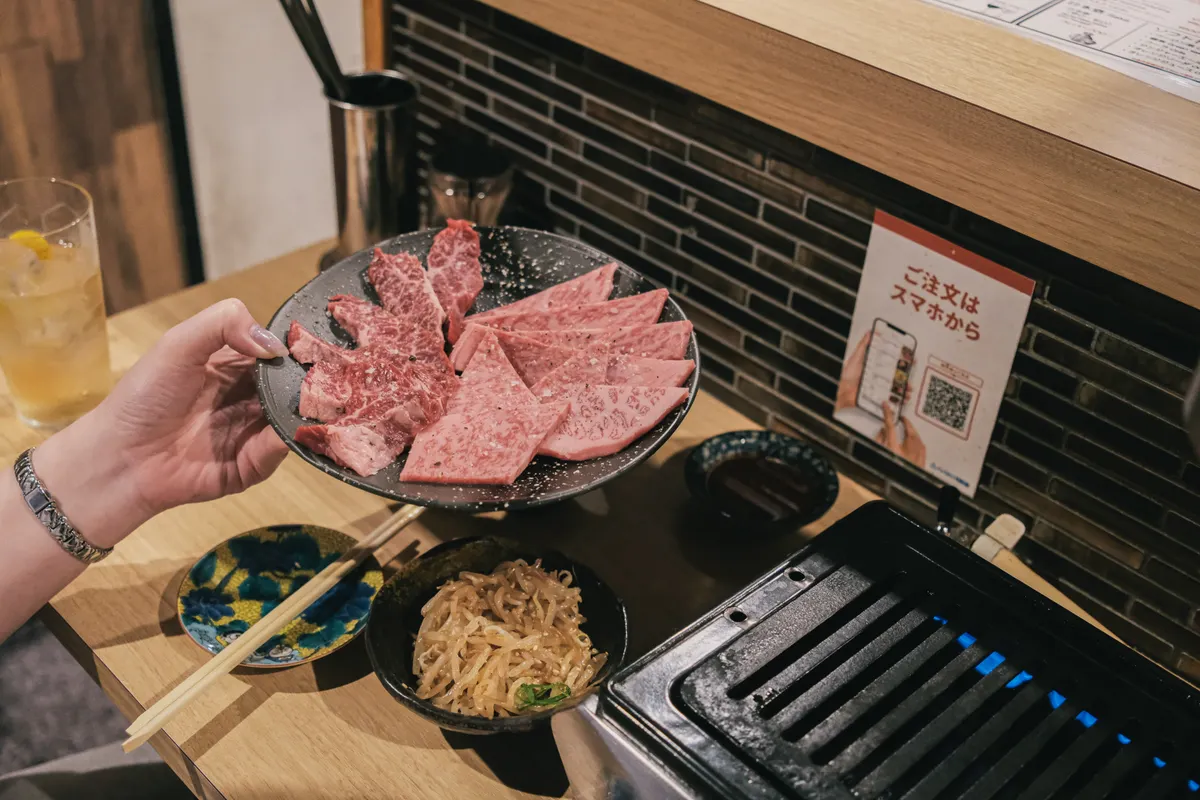

The Ushio London wagyu omakase experience, which opened at Hot Dinners reports 12 Charlotte Street on 28 July 2026, is one of those restaurants that you understand through the body before the brain catches up. You walk in off a warm Charlotte Street evening, bars at full tilt, that particular Fitzrovia noise of a city that has forgotten it has work in the morning, and the room simply absorbs you.
Ten seats. All at the counter. All facing the grill. The arithmetic is the point.
What the Ushio London Wagyu Omakase Counter Actually Offers
Dinner is served omakase: no printed menu, no choices to make, no decisions beyond whether to arrive at all. Chef Hakusei Chin leads the evening, moving through an eight-course wagyu tasting menu at a pace that feels genuinely unhurried. Every cut is prepared in front of the counter, which means you watch the angle of the knife, the moment the beef meets heat, the small adjustments made in real time. You see everything and still, somehow, the first bite surprises you.
That gap between watching and tasting is one of the evening’s more unusual pleasures. It is the kind of thing that sounds like a marketing line until it actually happens.
Early in the meal, guests receive a small illustrated diagram of a cow, the relevant cut stamped onto the illustration. By the end of the evening, it functions as a personal record of exactly what was eaten and from where on the animal. Transparent, gently educational, and utterly in keeping with the restaurant’s wider approach.
Drink pairings move naturally between sake, white wine, and red wine as the courses deepen. Nothing is predetermined; each pairing is chosen for the specific dish in front of you, which gives the progression a coherence that a fixed list rarely achieves.
The Philosophy Behind Akami, and Why It Matters Here
Ushio first opened in Fukuoka, Japan, around a decade ago, at a moment when Japanese wagyu was largely assessed by its marbling. The restaurant’s founding idea was to push back against that. Working primarily with female Japanese Black Wagyu, selected for fine grain and depth of flavour rather than sheer fat content, Ushio is built around the concept of akami. Often translated as lean meat, it represents something more considered here: a philosophy of choosing cuts that articulate the flavour of the beef itself, rather than using fat as a proxy for quality.
That philosophy unfolds across the eight courses in a sequence that is both logical and quietly instructive. The meal opens with finely chopped wagyu mixed with egg yolk, spring onion, and seaweed, a clean, immediate statement of intent. A house-dressed salad follows, serving as a palate reset before the grill sequence begins.
Tongue opens the grilled courses and is, notably, the only element not sourced from Japan. Because Japanese beef tongue is classified as offal, it cannot currently be imported into the UK; the kitchen spent months tasting alternatives before settling on what is served. Rump comes next, lean and firm, a direct illustration of akami. Kurimi with daikon and ponzu introduces slightly more marbling. The sirloin is the evening’s most indulgent moment, almost dissolving, before a lean sirloin immediately follows, a comparison that makes the point about the range of a single cut more effectively than any explanation could. The sequence closes with misuji, its marbling woven evenly through the meat, a considered final note.
Between the grill courses, each cut is first tempered over a bespoke Japanese hibachi designed specifically for Ushio, bringing the beef gradually to temperature before it meets the counter grill. The result is an evenness of cooking that is almost impossible to achieve otherwise. With the exception of the tongue, every piece of wagyu is selected and butchered by Ushio’s own specialist butcher shop in Fukuoka, the same operation behind the original restaurant. That provenance is not decorative.
A wagyu curry, made with slow-cooked beef tendon and a fragrant, precisely balanced spice blend, arrives as a counterpoint to the succession of grilled courses. It offers both contrast and a kind of comfort that the leaner cuts, by design, do not.
Late Nights by Design
One detail that places Ushio firmly within its Fukuoka origins: according to Hardens, the restaurant stays open until 12.30 on Friday and Saturday nights, a deliberate gesture towards the energy of Fukuoka’s late-night dining culture. It is the kind of operational decision that tells you something about a restaurant’s intentions. Ushio is not only importing a philosophy of beef; it is importing a particular relationship with the evening itself.
For a city that loves a counter and has grown sophisticated about Japanese dining, Ushio London arrives with a specific and well-formed point of view. Ten seats, one chef, one counter, and a decade of conviction behind every cut.
